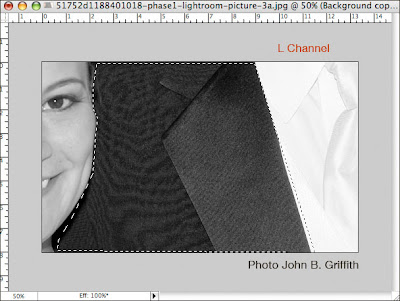
The textbook method is, as others mentioned, to suppress the texture in frequency space. I will explain how to find the correct filter, that you can basically do manually in (freeware java app). Download liar game season 1 sub indo mp4 full. When you open the program it is a strip of menu. The parts you need are: • File Open • Selection rectangle • Edit Crop • Process-> FFT -> FFT • Process-> FFT -> Inverse FFT • Paintbrush (with black color) First, load your image.
Then select the part that's only white with texture. Do FFT on this crop: You now notice a star pattern. This is the pattern to recognize when you open the image again, and do FFT on the whole thing: Now, don't remove the center point as that is the 'DC' value. Which means the average brightness. Use the paintbrush to eliminate the other stars. Make the black points big enough but not too big (play around with it).
If you overdo it, you will get banding around the edges and borders. Now do inverse FFT: (Note: You need to have the FFT image window selected when you try to do the inverse FFT.
Jul 10, 2010 It can be very useful for scans of printed material to remove print patterns (using Fourier filters). Moire, I'd pull them into Photoshop. Ebcs 10 electrical installation of buildingspdf line. Moire filter. Images Intended For Web Use Please Note: These changes should be made on your original image before the indexing/GIF procedure.
If you have the original image window selected, you'll get an error saying 'Frequency domain image required'.) And if you can do this at higher resolution than you need, you can downsize the image with lanczos resampling for an even better result: If you know some scripting or programming you could impose this elimination pattern automatically on an entire set. I would like to add my technique! • Scan the photo once as usual. • Rotate the photo 180% on the scanner and scan again. • In Photoshop, un-rotate the second scan. • Import it as a layer on top of the first scan.
• Auto-Align Layers using Photoshop command. • Assign second scan 50% opacity to blend images together. This technique comes from observing that the highlights and shadows of the photo paper texture are largely reversed when scanned from the opposite direction. Blending two such scans together cancels out most of the texture this way.
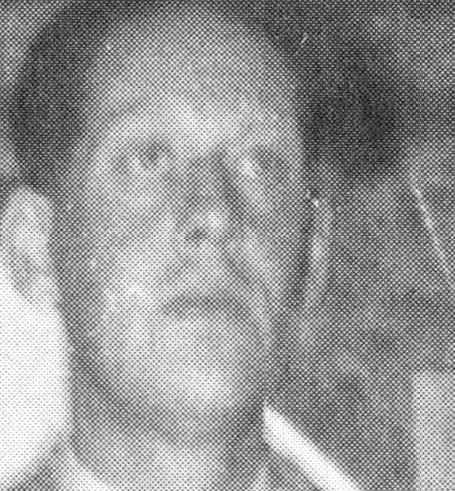
Obviously this doesn't clear it up 100%. Maybe 2 more scans at 90 and 270 degrees added to the mix would do more. But the big plus is that it DOESN'T remove any information from the photo, providing a much cleaner baseline which should require less-destructive settings in subsequent filtering. I was able to further clear things up a tiny bit by copy-pasting the 'Difference' between the two aligned scans into a new Difference level at about 10% opacity, but I've never been brilliant at those level filters at the bottom of the list. So your mileage may vary.